When to Replace Water Vending Machine Filters and Consumables
Replace each consumable at its time limit or at the first warning sign, whichever comes first. Cartridges commonly last up to 3 months and RO membranes 4–6 months. A rising pressure drop, slower filling or higher TDS means act sooner.
Cartridges fill with dirt, membranes foul and UV lamps lose strength. Change them too late and water quality suffers; change them too early and you waste money.
A time limit and the warning signs
Give every consumable a time limit, and replace it sooner at the first warning sign:
- Time: even on a quiet site, cartridges commonly need changing within 3 months. Carbon and post-filters left longer can grow bacteria.
- Warning signs: a pressure drop of about 0.5 bar (7 psi) across a prefilter, slower filling, higher product-water TDS, a change in taste or smell, or a failed water test.
Busy sites usually see the warning signs first; quiet sites reach the time limit first. To read the signs, note how long a 19 L jar takes to fill and the product-water TDS when the machine is new, and compare at similar water temperatures. A TDS meter does not show bacteria, so manufacturers commonly recommend a laboratory test every month.
What wears out in a vending cabinet
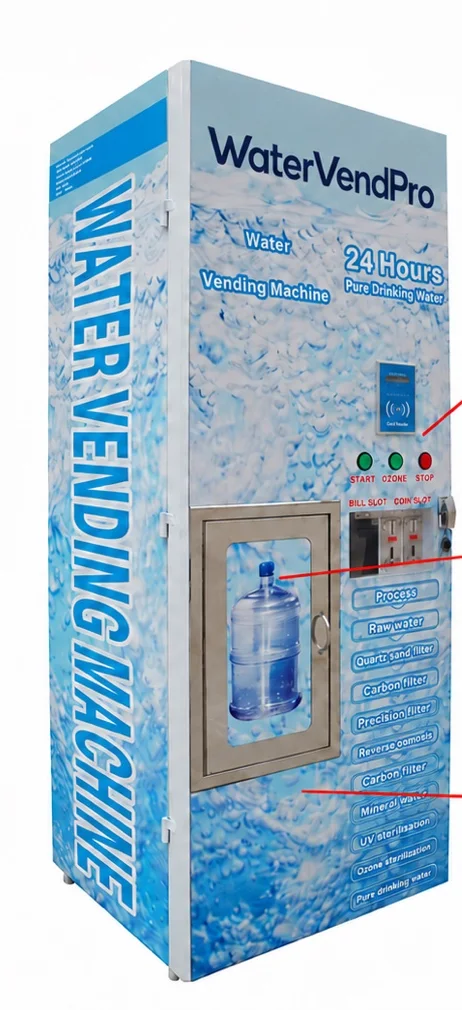
Most vending cabinets have treatment built in. Our blue cabinet, for example, carries sediment and carbon pre-treatment, reverse osmosis (RO), post-filtration, UV and ozone stages.
Your quotation lists the stages in your machine. These intervals are typical; your water and sales set your own:
| Consumable | Typical interval | Replace sooner if |
|---|---|---|
| Sediment (PP) cartridge | Up to 3 months | The pressure drop passes about 0.5 bar |
| Carbon cartridge | Up to 3 months | Chlorine shows after it |
| RO membrane | 4–6 months | Output or TDS has moved 10–15% and cleaning does not bring it back |
| Post-carbon and mineral cartridges | Up to 3 months | The taste changes or the water tastes flat |
| UV lamp | By operating hours, as the manual says | The indicator shows a fault. A lamp can glow after it stops disinfecting, so go by hours, and clean the quartz sleeve at each change |
What wears out in a separate RO system
A stand-alone system such as our stainless-steel RO system treats water in bulk for the cabinets. Its media last longer but need regular care:
| Stage | Routine care | Typical replacement |
|---|---|---|
| Sand and carbon filters | Backwash as the manual says | Sand: 1–2 years. Carbon: 6–12 months |
| Softener | Keep the salt topped up | When the signs below appear |
| Precision filter | Check the pressure drop weekly | Every 3 months, or at about 0.8 bar |
| RO membranes | Record output and TDS daily | 4–6 months |
Softener resin has no fixed replacement date. Test the hardness after the softener regularly, or have a service provider check it. Replace the resin when hardness or scale increases, the softener’s flow drops, or the resin turns noticeably darker or dirty. Healthy resin is light yellow to brown.
What shortens the schedule
| Situation | What to do |
|---|---|
| Chlorinated municipal water | Change carbon on time and test for chlorine after it: chlorine above about 0.1 mg/L damages a polyamide RO membrane. |
| Borehole water with iron or manganese | Test for both, add removal if needed, and check prefilters weekly. |
| Hard or high-TDS water | Use a softener or antiscalant, and check membrane output more often. |
| Tanker-delivered water | Clean the storage tank and test water from each supplier. |
| Hot climate or direct sun | Shade the cabinet and sanitise more often. Warm water also raises TDS a little. |
| Out of use for more than 3 days | Disinfect, flush and replace the post-carbon cartridge, then test the water before selling. |
If a water test fails or customers report a change in taste, stop selling. Sanitise the machine, replace the post-filtration, check the UV lamp and retest before you reopen.
Service routine
Site staff can do the weekly checks: prefilter pressures, filling time, TDS and softener salt. Leave membrane, UV and disinfection work to a trained technician, and disinfect the storage tank, filter housings and dispensing parts every 6 months.
Log every visit: the date, litres sold, TDS, prefilter pressures, filling time and parts replaced. Inspectors may ask for it; California, for example, requires servicing at least every 31 days and records kept for two years.
Keep a spare set of cartridges and a UV lamp on hand, so a due change never waits for a delivery. For the full set of running costs, see Water Vending Machine Price: What Affects the Cost.
Filter cartridges and other consumables are excluded from warranty coverage, so budget for them from day one.
Frequently asked questions
Can I change all the filters on the same day every quarter?
For the cartridges, yes, unless a warning sign comes first. Membranes, UV lamps and softener resin follow their own schedules, so time them from your log.
Should I clean the RO membrane or replace it?
Clean it when output or TDS has moved 10–15% from its starting value. If they do not recover after cleaning, replace the membrane.
Are filters covered by the warranty?
No. Filter cartridges and other consumables are excluded; warranty duration and coverage are agreed with your order.